How to Get the Most Value From Air Duct Cleaning in Salt Lake City Today
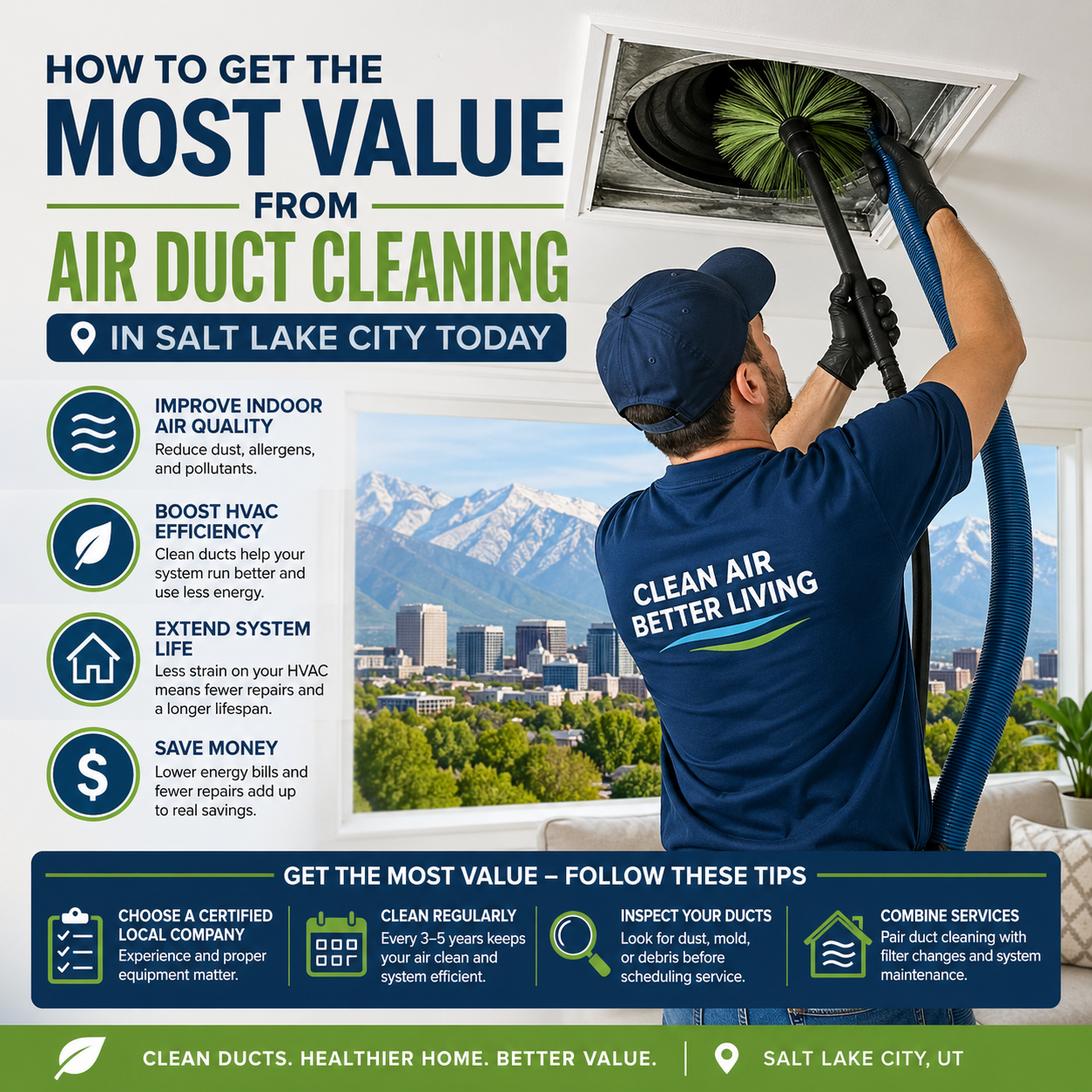
Introduction: Why Your Air Ducts Deserve More Attention Than They Get
Most homeowners in Salt Lake City think about their HVAC system exactly twice a year: once when summer heat hits and the air conditioner groans to life, and once when the first hard freeze of autumn reminds them the furnace exists. The ductwork hiding behind your walls and above your ceilings? That gets almost no attention at all, and that neglect has real consequences.
Utah's unique geography creates some of the worst air quality conditions in the country. The Salt Lake Valley sits in a natural bowl surrounded by the Wasatch and Oquirrh mountain ranges, and during winter temperature inversions, pollutants, particulate matter, and allergens get trapped at ground level for days or even weeks at a time. That outdoor air finds its way inside. It circulates through your home via your HVAC system. And over months and years, a significant portion of it settles inside your ductwork.
Add to that the region's dry, dusty climate, the prevalence of home renovation projects that kick up construction debris, and the fact that many Salt Lake homes were built before modern sealing standards, and you have a recipe for heavily contaminated duct systems that silently undermine both your indoor air quality and your heating and cooling efficiency.
This article is your complete guide to understanding when you need duct cleaning, how to choose a qualified contractor, what the process actually involves, and how to make sure every dollar you spend delivers lasting value. Whether you are a long-time resident or recently relocated to Utah, these insights will help you make a well-informed decision rather than a reactive one.
Section 1: Understanding What Lives Inside Your Ducts (And Why It Matters)
Before you can appreciate the value of having your ducts cleaned, it helps to understand what accumulates inside them over time. According to the U.S. Environmental Protection Agency's overview of indoor air quality, indoor air can be two to five times more polluted than outdoor air, and in some cases even more so. A significant contributor to that statistic is the duct system circulating air through your home repeatedly, day after day.
Inside a typical residential duct system that has gone several years without cleaning, you are likely to find a combination of the following:
Dust and debris accumulation. Every time your HVAC system runs, it pulls in air through a return vent, conditions it, and pushes it out through supply vents. That air carries microscopic particles. Your filter catches many of them, but not all, especially if the filter is not changed regularly or if the system runs with a poorly fitting filter. Over time, a visible layer of dust coats the inside walls of your ducts, and portions of that dust re-enter your living spaces with every cycle.
Biological contaminants. Mold, mildew, bacteria, and in some cases even rodent or insect debris can take up residence in ductwork. This is especially true in homes that have experienced moisture intrusion, plumbing leaks near air handler units, or that have suffered from flooding. Salt Lake City's dry climate reduces but does not eliminate mold risk, and certain areas of the valley near the Jordan River corridor or lower-elevation neighborhoods with higher humidity can be more susceptible.
Pet dander and allergens. Homes with dogs, cats, or other pets accumulate dander at an accelerated rate. That dander becomes airborne and infiltrates the duct system continuously. For family members with asthma or allergies, this can be a significant quality-of-life issue that no amount of surface cleaning will fully resolve.
Construction and renovation debris. If your home has undergone any remodeling in the past decade, there is a reasonable chance that drywall dust, insulation fibers, or other particulates made their way into your duct system during the work. These materials are fine enough to pass through standard filters and coarse enough to linger inside ducts for years.
Volatile organic compounds (VOCs). Paints, adhesives, cleaning products, and off-gassing from new furniture all contribute compounds that can adsorb onto dust particles inside your ducts. While cleaning the ducts does not eliminate VOCs from their source, removing the dust that carries them can meaningfully reduce ongoing exposure.
Understanding this inventory helps you frame duct cleaning not as a luxury or a maintenance fad, but as a legitimate step toward a healthier living environment, particularly in a city with documented seasonal air quality challenges.
Section 2: Recognizing the Signs That Your System Needs Attention Now
Not every home needs duct cleaning on an identical schedule. The National Air Duct Cleaners Association (NADCA) generally recommends professional cleaning every three to five years for most residences, but several conditions warrant more immediate attention regardless of when the last service was performed.
Visible dust discharge at vents. If you notice puffs of dust emerging from supply vents when the system first kicks on, that is a clear signal that debris has built up to the point of becoming airborne. This is often most visible against dark flooring or in rooms that receive direct morning sunlight.
Rising energy bills without explanation. When duct walls are coated with particulate buildup, airflow is restricted. Your HVAC system has to work harder and run longer to achieve the same temperature targets. If your gas or electric bills have climbed over the past few years without a corresponding increase in usage habits or utility rates, compromised duct efficiency may be a contributing factor. A Forbes analysis of home energy performance notes that clean duct systems can meaningfully improve HVAC efficiency, reducing operational costs over time.
Uneven heating or cooling throughout the home. If certain rooms are consistently harder to heat or cool than others and you have ruled out insulation problems and window drafts, partial blockages in your duct system may be redirecting airflow away from those spaces.
Musty or stale odors when the system runs. Odors that appear or intensify when your HVAC is operating suggest biological growth or significant debris accumulation inside the system. This is one of the stronger indicators that inspection and cleaning are overdue.
Recent home purchase. If you have moved into a home and cannot verify when the ducts were last cleaned or whether the previous occupants had pets, smokers in the household, or completed any renovations, scheduling an inspection as part of your settling-in process is a smart precaution.
New construction or major renovation. Even brand-new homes can have construction debris in their duct systems. Builders often run HVAC systems during construction without filters in place to prevent system damage, which means debris from framing, drywalling, and painting can settle throughout the ductwork.
Recognizing these signs early gives you the opportunity to act before minor buildup becomes a serious problem affecting both your health and your HVAC system's lifespan.
Section 3: What a Professional Duct Cleaning Service Actually Involves
One reason homeowners sometimes feel uncertain about duct cleaning is that the process is largely invisible. The contractor does most of the work inside walls and above ceilings, and it can be hard to know whether the job has been done thoroughly or superficially. Understanding the proper process from start to finish helps you hold service providers accountable and recognize when corners are being cut.
Inspection before work begins. A reputable contractor will perform a visual inspection of your duct system before quoting or beginning work. This typically involves the use of a small camera inserted into access points throughout the system. The inspection identifies areas of heavy buildup, any signs of mold or pest activity, damaged sections of ductwork, and portions of the system that may require sealing or repair in addition to cleaning.
Source removal with negative pressure. The industry standard for effective duct cleaning is the source removal method, which uses powerful vacuum equipment to create negative pressure inside the duct system. This negative pressure prevents loosened debris from escaping into your living spaces during the cleaning process. NADCA-certified contractors are trained to use this approach, and it is the method recommended in the EPA's guidance on duct cleaning practices.
Agitation to dislodge buildup. Vacuum suction alone is not sufficient to remove debris that has adhered to duct walls over years of accumulation. Technicians use a combination of rotating brushes, compressed air whips, and other agitation tools to break buildup loose so it can be captured by the vacuum system. The type of agitation used should be appropriate for your specific duct material, whether that is sheet metal, flexible duct, or fiberboard, to avoid causing damage during the process.
Cleaning the system components. A complete duct cleaning service does not stop at the ducts themselves. Coil cleaning, blower cleaning, and drain pan cleaning are important components of a thorough job. The EPA notes that if only the ducts are cleaned while contaminated system components are left in place, recontamination can occur quickly.
Sanitizing and sealing when appropriate. In cases where mold growth or biological contamination is identified, application of an EPA-registered sanitizing agent may be appropriate. This step should be recommended based on documented findings, not offered as a default upsell. Similarly, duct sealing to address leaks discovered during the process is a legitimate and often high-value add-on service that improves both air quality and system efficiency.
Post-cleaning verification. A thorough contractor will conduct a post-job inspection to confirm that the system is clean before considering the job complete. Ask to see before-and-after photos or video footage from the inspection camera, as these provide objective evidence of the work completed.
When you are evaluating service providers for air duct cleaning salt lake city residents should specifically ask about NADCA certification, the type of vacuum equipment used, whether they perform a pre-cleaning inspection, and whether they will provide documentation of findings. These questions quickly distinguish professional operations from low-cost companies that offer coupon deals and rush through homes in under an hour.
Section 4: Making Your Investment Last: Post-Cleaning Best Practices
Getting your ducts professionally cleaned is a meaningful investment in your home's air quality and HVAC performance. But the value of that investment depends heavily on what you do in the months and years that follow. A few consistent habits can extend the results of a professional cleaning significantly and reduce the frequency with which repeat service is needed.
Upgrade your filter and change it regularly. The single most impactful thing most homeowners can do to protect their duct system is to use a quality air filter and replace it on schedule. Research on indoor air filtration and particulate capture consistently supports the use of filters rated MERV 8 through MERV 11 for residential applications. These filters capture a much higher percentage of the fine particles that would otherwise enter and circulate through your duct system, without the airflow restriction associated with higher-rated MERV 13 and above filters that can stress residential systems.
Filters in Utah homes often need to be changed more frequently than the packaging suggests, especially during inversion season when outdoor particulate levels spike. Checking your filter monthly and replacing it when it shows visible loading, rather than on a fixed calendar schedule, is a more responsive approach.
Control indoor humidity. Excess moisture is the primary driver of mold growth in duct systems. In Salt Lake City, winter months are typically dry enough that humidification is actually needed rather than dehumidification. But in summer, particularly in lower-lying areas of the valley or in homes with evaporative coolers, humidity can rise enough to create conditions favorable to biological growth. Maintaining indoor relative humidity between 35 and 50 percent limits this risk substantially.
Seal leaks in the building envelope. Air infiltration from outside brings in the same particulate matter and allergens that make your ducts dirty in the first place. Weatherstripping around doors and windows, caulking gaps around utility penetrations, and sealing attic bypasses all reduce the volume of outdoor air, and the contaminants it carries, entering your home.
Schedule regular HVAC maintenance. Annual tune-ups for your heating and cooling equipment serve double duty. They keep your system running efficiently and at peak performance, and they give a trained technician the opportunity to identify emerging problems inside the air handler, on the coil, or in the ductwork before they become expensive repairs or health concerns. Many Salt Lake HVAC companies offer maintenance agreements that make this easy to stay on top of.
Be strategic about renovations. If you are planning any home improvement work that involves cutting into walls, sanding, or other dust-generating activities, taking steps to isolate your HVAC system during the project can prevent years' worth of debris from entering your ducts in a single day. Turning off the system during dusty phases of work and using plastic sheeting to cover return vents are simple precautions that pay dividends.
Conclusion: Breathe Better, Spend Smarter, and Take Action Today
The air inside your Salt Lake City home tells a story. It carries evidence of how well your HVAC system has been maintained, what activities have taken place inside, and how effectively the building has been protected from the challenging outdoor air quality conditions the Wasatch Front is known for. A clean duct system does not guarantee perfect indoor air, but it removes one of the most significant and addressable contributors to indoor contamination.
The value you get from professional duct cleaning is not just measured on the day the technicians leave. It shows up over months in lower energy bills, in fewer allergy symptoms for family members, in the reduced frequency of dusting and vacuuming required to keep surfaces clean, and in the extended lifespan of HVAC equipment that is not straining against restricted airflow.
The key to getting that value is approaching the process thoughtfully: hiring a certified, reputable contractor; understanding what a thorough cleaning actually involves; and following up with the habits and maintenance practices that protect your investment over time.
Your Call to Action: If it has been more than three years since your last duct inspection, if you have recently moved into a home with an unknown maintenance history, or if you have noticed any of the warning signs described in this article, now is the right time to act. Contact a NADCA-certified duct cleaning professional in the Salt Lake area, ask the right questions, and schedule an inspection. The investment is modest relative to the benefits, and the difference in your home's air quality and comfort may be more noticeable than you expect.
Κατηγορίες
Διαβάζω περισσότερα
Enchanting Folklore Comes to Life in Finnish Fantasy Film In a delightful twist on traditional Scandinavian folklore, Finland has produced a cinematic gem that captivated domestic audiences with its whimsical narrative and stunning visuals. This family-friendly fantasy tale centers on an unlikely relationship that develops amid tensions between two mythical species. The film's impressive...

Waylay, nouvelle duelliste lumineuse L'heure de la nouveauté sonne dans l'univers de VALORANT. Une duelliste d'origine thaïlandaise, Waylay, se prépare à faire son entrée. Son arsenal repose sur une maîtrise inédite de la lumière. Elle pourra se transformer en particules lumineuses, une capacité de mobilité et d'esquive unique....
Depuis sa sortie, Genshin Impact a rapidement captivé un large public grâce à son esthétique rappelant celle de The Legend of Zelda : Breath of the Wild. Les chiffres de ses revenus ne cessent de croître, attestant de son immense popularité. Selon Sensor Tower, le jeu aurait généré environ 60 millions de dollars seulement durant la...
Recent leaks about Honkai: Star Rail have shed light on the upcoming character Castorice, revealing intriguing details about her unique abilities. Scheduled to debut in version 3.2 as a five-star quantum remembrance unit, she has captivated fans since her initial appearance in the 3.0 update during the journey to Amphoreus. Fans first encountered her as a Chrysos heir capable of affecting...
Romance in the Countryside Winter Retreat: Thompson and Ha's On-Screen Chemistry Blossoms at Rural Estate Luke Thompson and Yerin Ha will share an intimate storyline at a countryside property in the upcoming installment of the popular Regency-era romance series. The pair recently revealed that their characters' pivotal relationship development occurs during an extended sequence at a rural...