SPARK Matrix™: Industrial DataOps 2026 – Ranking the Leaders Driving Industrial Intelligence
In today's rapidly evolving industrial landscape, data has become one of the most valuable assets for organizations seeking to improve efficiency, accelerate innovation, and maintain a competitive advantage. Modern manufacturing facilities, energy plants, utilities, and industrial enterprises generate enormous volumes of data from connected machines, sensors, control systems, and business applications every second. However, transforming this data into actionable insights remains a significant challenge. This is where the Industrial DataOps Market is emerging as a critical driver of digital transformation across industrial sectors.
As organizations continue to invest in Industry 4.0 initiatives, smart manufacturing, Industrial Internet of Things (IIoT), and advanced analytics, the need for efficient data management has never been greater. Industrial environments often operate with fragmented data sources spread across operational technology (OT), information technology (IT), engineering systems, and business applications. Without a unified approach to managing this information, organizations struggle to gain meaningful insights and maximize the value of their digital investments.
Industrial DataOps software addresses these challenges by providing a comprehensive framework for collecting, integrating, contextualizing, governing, and utilizing industrial data. These platforms enable organizations to streamline data operations while ensuring that stakeholders across operations, engineering, IT, and analytics teams can access trusted and actionable information. As a result, businesses can make faster decisions, improve productivity, enhance asset performance, and drive operational excellence.
The growing importance of industrial data has significantly accelerated the adoption of solutions within the Industrial DataOps Market. Organizations increasingly recognize that data silos can hinder innovation and limit visibility across operations. Industrial DataOps platforms help bridge these gaps by creating a seamless flow of information between traditionally disconnected systems. This capability enables enterprises to establish a single source of truth, improving collaboration and enabling data-driven decision-making across the organization.
One of the primary drivers fueling market growth is the increasing deployment of connected devices and smart equipment. Manufacturing plants, energy facilities, and industrial operations are generating unprecedented amounts of operational data through sensors, automation systems, robotics, and IIoT devices. While this data offers tremendous opportunities for optimization, extracting meaningful insights requires advanced data integration and management capabilities. Industrial DataOps solutions provide the necessary infrastructure to manage these growing data volumes efficiently.
The rise of predictive maintenance initiatives has also contributed to growing demand. Organizations are leveraging advanced analytics and machine learning models to predict equipment failures before they occur. These predictive capabilities depend on the availability of high-quality, contextualized industrial data. Industrial DataOps platforms help ensure data accuracy, consistency, and accessibility, enabling organizations to implement more effective maintenance strategies while reducing downtime and operational costs.
Another key factor driving the market is the increasing adoption of artificial intelligence and advanced analytics. Industrial enterprises are investing heavily in AI-powered applications to optimize production processes, improve quality control, and enhance supply chain visibility. However, the effectiveness of these technologies depends on the quality and accessibility of underlying data. By streamlining data preparation and integration processes, Industrial DataOps solutions enable organizations to maximize the value of AI and analytics investments.
Cloud adoption is further reshaping the industrial technology landscape. Many organizations are transitioning from traditional on-premises infrastructure to hybrid and cloud-based environments to improve scalability, flexibility, and collaboration. Industrial DataOps platforms play a critical role in supporting these transformations by facilitating secure and efficient data movement between edge systems, industrial assets, and cloud environments. This capability enables organizations to unlock greater business value while maintaining operational continuity.
The competitive landscape within the Industrial DataOps Market continues to evolve as technology providers introduce innovative capabilities designed to address emerging customer requirements. Vendors are focusing on real-time data integration, low-code development environments, AI-driven analytics, advanced governance frameworks, and enhanced cybersecurity features. These innovations help organizations simplify complex data management processes while improving data quality and operational performance.
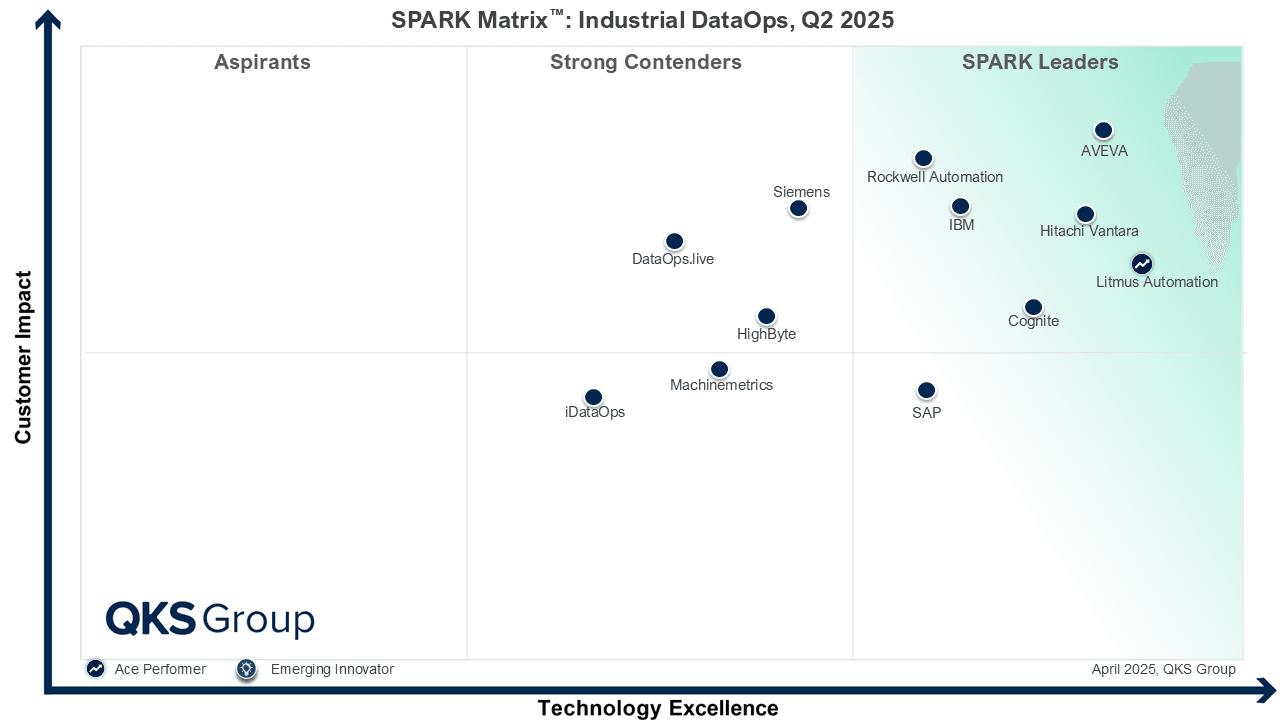
QKS Group's comprehensive market research offers valuable insights into this dynamic industry through detailed competitive analysis and vendor evaluations. The research examines leading market participants and assesses their strengths across technology excellence, customer impact, market presence, and strategic vision. Through its proprietary SPARK Matrix™ methodology, QKS Group provides an in-depth analysis of vendor positioning and competitive differentiation.
The SPARK Matrix™ for Industrial DataOps includes leading vendors such as AVEVA, Cognite, DataOps.live, HighByte, Hitachi Vantara, IBM, Litmus Automation, MachineMetrics, Rawcubes, Rockwell Automation, SAP, and Siemens. These companies are helping organizations transform industrial data into actionable intelligence through advanced software platforms that support operational efficiency, business agility, and digital transformation.
Cybersecurity and data governance have become increasingly important considerations as industrial organizations expand their digital ecosystems. The growing convergence of IT and OT environments introduces new security challenges that require robust protection mechanisms. Modern Industrial DataOps platforms incorporate advanced governance capabilities, access controls, data lineage tracking, and security frameworks to help organizations maintain compliance and protect critical operational data.
Looking ahead, the market is expected to experience substantial growth as organizations continue investing in digital transformation initiatives. The increasing adoption of smart factories, autonomous operations, AI-driven analytics, and industrial cloud platforms will further elevate the importance of effective data management strategies. Organizations that successfully leverage Industrial DataOps capabilities will be better positioned to improve operational efficiency, accelerate innovation, and achieve sustainable competitive advantages.
As industrial enterprises continue generating larger volumes of data, the ability to transform that information into actionable business intelligence will become a defining factor for success. Industrial DataOps Market provides the foundation necessary to unlock this value by connecting people, processes, and technology through a unified data strategy. For organizations seeking to maximize operational performance and future-proof their digital transformation efforts, Industrial DataOps is rapidly becoming an essential component of modern industrial operations.
Kategorien
Mehr lesen
Marvel Rivals is set to launch on December 6 across PC, Xbox Series X/S, and PS5, but early gameplay footage of Black Widow has already stirred controversy. The character appears to land headshots that instantly eliminate opponents, prompting worried fans to draw unfavorable comparisons to Overwatch’s Widowmaker and call for nerfs before the game even releases. Developer Reassures the...

To enhance your precision while moving through the map, consider adjusting the swing mechanics in your settings. The default assist feature may smooth initial gameplay but often limits aiming accuracy during traversal. Access the options menu to find the control or gameplay settings section. Look for the toggle labeled easy swing and switch it off to gain full manual control. This quick change...
As spring unfolds, the cybersecurity community is buzzing with activity, especially during the CanSecWest conference season. One of the highlights this year involves a groundbreaking vulnerability targeting System Management Mode (SMM) memory, a critical component in modern Intel-based systems. Remarkably, two independent research groups have uncovered this flaw. The Invisible Things Lab, led...
Warner Bros. Discovery executives David Zaslav and JB Perrette highlighted promising developments across the company's film, streaming, and gaming divisions during Thursday's earnings call, though conspicuously sidestepping the elephant in the room regarding ongoing merger discussions. The 40-minute Q4 earnings session made no mention of the high-stakes bidding war between Netflix and...
Record-Breaking M5 Final Viewership The grand final of the M5 World Championship featuring ONIC Esports and AP Bren set a new high for peak viewership, as reported by the analytics firm Esports Charts. Approximately five million spectators tuned in to watch the intense showdown, eclipsing the previous record of 4.2 million viewers. That earlier record was established during the M4 World...