The Warning Before the Crash: How Forward Collision Warning Technology Alerts Drivers in Time
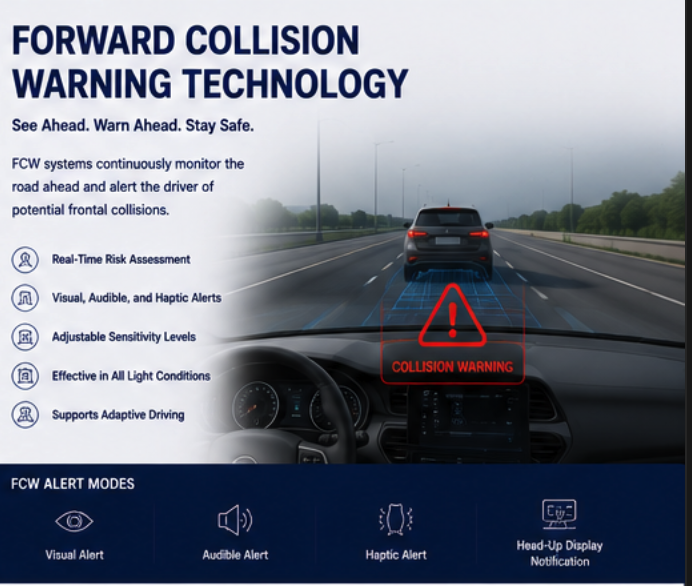
A split second of distraction can cause a lifetime of regret. Forward Collision Warning Technology is designed to break through driver distraction, providing urgent alerts when a crash is imminent. Unlike automatic braking (which takes control), FCW empowers the driver to act—but it must do so in a way that is impossible to ignore. These warning systems are a critical component of Advanced Driver Assistance Systems (ADAS), giving drivers the information they need to react in time.
What Is Forward Collision Warning (FCW)?
FCW is an active safety system that monitors the road ahead and alerts the driver when a collision with a vehicle, pedestrian, or other obstacle is imminent. Unlike Automatic Emergency Braking (AEB), FCW does not apply the brakes—the driver must take action. But a timely warning can be just as effective, allowing the driver to brake or steer away.
FCW vs. AEB: Complementary Systems:
| Feature | FCW (Warning Only) | AEB (Active Intervention) |
|---|---|---|
| Action | Alerts driver | Applies brakes automatically |
| Driver action required | Yes (brake or steer) | No (system acts if driver does not) |
| Effectiveness (alone) | 20-30% reduction | 50-60% reduction |
| Best for | Distracted drivers | Unresponsive drivers |
Most vehicles combine FCW and AEB: FCW alerts first; if the driver does not respond, AEB activates.
How FCW Works: Sensing the Threat
Forward Collision Warning Technology uses sensors to detect potential collisions:
Primary Sensors:
| Sensor | Role | Characteristics |
|---|---|---|
| Forward camera | Detects obstacles, reads signs | 50-150m range, degraded by weather |
| Long-range radar | Measures distance and closing speed | 150-250m range, all-weather |
| LiDAR (premium) | Precise 3D mapping | 100-200m range, expensive |
Sensor Fusion in FCW:
| Condition | Primary Sensor | Backup |
|---|---|---|
| Daylight, good weather | Camera (identifies threat type) | Radar (confirms distance) |
| Night or poor weather | Radar (measures distance/velocity) | Camera (if usable) |
| Direct sun glare | Radar (only) | None |
FCW Calculation: Time-to-Collision (TTC)
FCW is triggered based on Time-to-Collision (TTC):
TTC = Distance / Relative Speed
FCW Trigger Thresholds (Typical):
| TTC | Threat Level | FCW Action |
|---|---|---|
| 3.0-4.0 seconds | Low | None (monitoring only) |
| 2.0-3.0 seconds | Medium | Prepare for warning |
| 1.2-2.0 seconds | High | Initial warning (visual/audible) |
| < 1.2 seconds | Critical | Urgent warning + AEB activation |
The FCW Alert System: Getting Your Attention
Forward Collision Warning Technology uses multiple channels to alert the driver:
Visual Alerts:
| Type | Location | Effectiveness |
|---|---|---|
| Flashing red LED | Windshield (head-up display) | High (in peripheral vision) |
| "BRAKE!" text | Instrument cluster | Medium (requires looking down) |
| Flashing red outline | Head-up display (if equipped) | Very high (directly in line of sight) |
| Red dashboard icon | Instrument cluster | Low (easy to miss) |
Audible Alerts:
| Type | Characteristics | Effectiveness |
|---|---|---|
| Beeping (repeating) | Increases frequency as threat escalates | High |
| Chime (single tone) | One-time alert | Medium |
| Voice alert ("Brake!") | Spoken warning | Very high (commands action) |
Haptic Alerts (Tactile):
| Type | Characteristics | Effectiveness |
|---|---|---|
| Steering wheel vibration | 2-5 second pulse | Very high (impossible to ignore) |
| Seat vibration (driver only or both sides) | Directional (left/right) | Very high |
| Brake pulse (brief, light braking) | 0.5-1.0 second pulse | High (feels like ABS activation) |
Haptic alerts are the most effective because they engage the sense of touch, which is rarely used in normal driving.
Escalation Strategy: From Warning to Action
Modern FCW systems use an escalation strategy:
-
Visual alert only (low threat): Flashing icon, minimal distraction.
-
Visual + audible (medium threat): Flashing icon + beeping.
-
Visual + audible + haptic (high threat): Flashing "BRAKE!" + urgent beeping + steering wheel vibration.
-
AEB activation (critical threat): System brakes automatically.
FCW Performance: Does It Actually Work?
Data from the IIHS and NHTSA shows FCW effectiveness:
| Scenario | Collision Reduction (FCW only) |
|---|---|
| Rear-end crashes (all) | 20-30% reduction |
| Rear-end crashes with injuries | 25-35% reduction |
| Fatal rear-end crashes | 10-20% reduction |
FCW + AEB Combined:
| Scenario | Collision Reduction (FCW + AEB) |
|---|---|
| Rear-end crashes (all) | 50-60% reduction |
| Rear-end crashes with injuries | 55-65% reduction |
Driver Response to Warnings
Studies of driver behavior show:
| Warning Type | Driver Reaction Time | Appropriate Response Rate |
|---|---|---|
| Visual only | 1.2-1.5 seconds | 60-70% |
| Visual + audible | 0.8-1.0 seconds | 75-85% |
| Visual + audible + haptic | 0.5-0.8 seconds | 85-95% |
Haptic alerts (steering wheel or seat vibration) produce the fastest reactions.
False Positives: The Boy Who Cried Wolf
FCW systems occasionally alert when there is no actual threat (e.g., a metal plate in the road, a shadow, a vehicle in an adjacent curve). Frequent false positives cause drivers to ignore or disable the system.
Common False Positive Causes:
| Cause | Mitigation |
|---|---|
| Metal plates or grates | Lateral filtering (ignore objects not in path) |
| Sharp shadows (trees, bridges) | Improved object classification (shadow vs. vehicle) |
| Overhead signs | Map integration (know sign positions) |
| Vehicles in adjacent lanes on curves | Predictive path modeling |
False Positive Rates:
| System Generation | False Positive Rate (per 1000 miles) |
|---|---|
| Early FCW (2015) | 5-10 |
| Mid-generation (2020) | 2-5 |
| Modern FCW (2025) | 0.5-2 |
FCW for Pedestrians and Cyclists
FCW is not limited to vehicles. Pedestrian and cyclist detection is increasingly common:
Pedestrian FCW:
| Condition | Detection Confidence | Effectiveness |
|---|---|---|
| Daylight, clear view | High | 30-40% reduction |
| Night, lit streets | Medium | 20-30% reduction |
| Night, unlit streets | Low | 5-15% reduction |
| Child pedestrians | Medium (smaller target) | 15-25% reduction |
Cyclist FCW:
| Condition | Detection Confidence | Effectiveness |
|---|---|---|
| Day, clear view | High | 25-35% reduction |
| Night | Low | 5-15% reduction |
FCW Limitations
Advanced Driver Assistance Systems (ADAS) have limitations:
| Limitation | Impact |
|---|---|
| Weather dependence | Rain, snow, fog reduce camera effectiveness |
| Darkness | Pedestrian detection degraded |
| High speeds | TTC becomes very short, warning may come too late |
| Winding roads | Objects appear suddenly |
| Driver override | Driver can ignore the warning |
The Future of Forward Collision Warning
-
Predictive FCW: Using GPS and map data to anticipate threats (curves, intersections) before they are visible.
-
Augmented reality (AR) warnings: Highlighting the threat directly on the windshield (AR head-up display).
-
Directional haptics: Vibrating the seat on the side where the threat is approaching.
-
Driver state adaptation: Adjusting warning timing and intensity based on driver distraction level (detected by driver monitoring camera).
Conclusion
Forward Collision Warning Technology gives drivers something invaluable—time. Time to brake, time to steer, time to avoid a crash. By combining visual, audible, and haptic alerts, FCW cuts through distraction and demands immediate attention. As part of Advanced Driver Assistance Systems (ADAS), FCW is the voice that says "LOOK OUT!" when you cannot say it yourself. The warning before the crash saves lives.
Kategorien
Mehr lesen
David Dobkin, known for his work on films like "The Judge" and "Wedding Crashers," has been tapped to helm "Eurovision" for the streaming giant Netflix. The project features Will Ferrell in a dual capacity—both as the lead actor and co-writer alongside Andrew Steele. Behind the scenes, the production team includes Jessica Elbaum, Chris Henchy, and Ferrell himself under the Gary Sanchez...

The global Avena Sativa Market is experiencing steady expansion due to rising consumer preference for natural, plant-based, and functional ingredients across food, cosmetic, and animal feed industries. Avena sativa (oats) is widely recognized for its nutritional benefits, including high fiber content and wellness properties, making it a key ingredient in health-focused product formulations....
La bannière nostalgie « Quiétude sous la rosée » est disponible jusqu’au 19 mai. Elle fonctionne avec le système de Vœux Nostalgie : tu sélectionnes un personnage ou une arme 5★ parmi ceux proposés, puis tu obtiens soit l’objet choisi directement (victoire du 50/50), soit un autre 5★ de la bannière qui active la...
The Custom Software Development Market is expected to experience significant growth in the coming years as organizations prioritize innovation, automation, and digital transformation. The market outlook is positive, driven by technological advancements, increasing demand for tailored solutions, and the growing importance of cybersecurity and regulatory compliance. One of the key factors shaping...

Damage Mechanics Overview Extraction shooters tend to feature more sophisticated damage mechanics for armor and ammunition than traditional first-person shooters. Delta Force’s operations mode follows this trend, albeit with a somewhat streamlined approach compared to games like Escape from Tarkov. Selecting the appropriate armor and ammunition is crucial, as it directly impacts your...