The Warning Before the Crash: How Forward Collision Warning Technology Alerts Drivers in Time
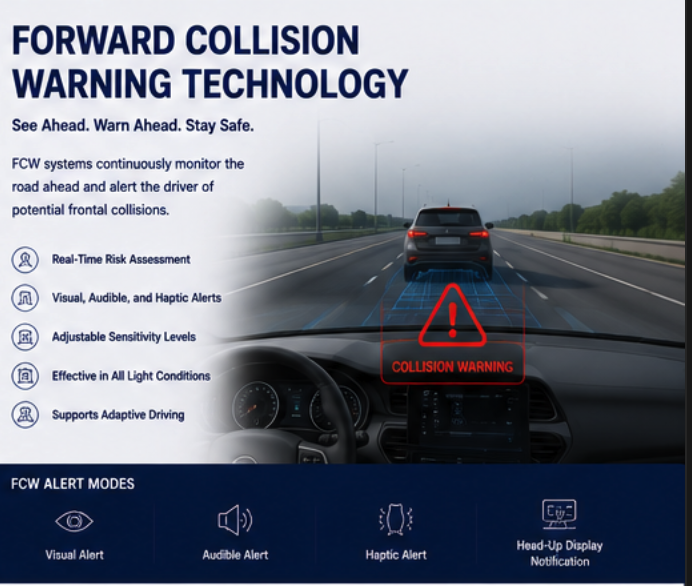
A split second of distraction can cause a lifetime of regret. Forward Collision Warning Technology is designed to break through driver distraction, providing urgent alerts when a crash is imminent. Unlike automatic braking (which takes control), FCW empowers the driver to act—but it must do so in a way that is impossible to ignore. These warning systems are a critical component of Advanced Driver Assistance Systems (ADAS), giving drivers the information they need to react in time.
What Is Forward Collision Warning (FCW)?
FCW is an active safety system that monitors the road ahead and alerts the driver when a collision with a vehicle, pedestrian, or other obstacle is imminent. Unlike Automatic Emergency Braking (AEB), FCW does not apply the brakes—the driver must take action. But a timely warning can be just as effective, allowing the driver to brake or steer away.
FCW vs. AEB: Complementary Systems:
| Feature | FCW (Warning Only) | AEB (Active Intervention) |
|---|---|---|
| Action | Alerts driver | Applies brakes automatically |
| Driver action required | Yes (brake or steer) | No (system acts if driver does not) |
| Effectiveness (alone) | 20-30% reduction | 50-60% reduction |
| Best for | Distracted drivers | Unresponsive drivers |
Most vehicles combine FCW and AEB: FCW alerts first; if the driver does not respond, AEB activates.
How FCW Works: Sensing the Threat
Forward Collision Warning Technology uses sensors to detect potential collisions:
Primary Sensors:
| Sensor | Role | Characteristics |
|---|---|---|
| Forward camera | Detects obstacles, reads signs | 50-150m range, degraded by weather |
| Long-range radar | Measures distance and closing speed | 150-250m range, all-weather |
| LiDAR (premium) | Precise 3D mapping | 100-200m range, expensive |
Sensor Fusion in FCW:
| Condition | Primary Sensor | Backup |
|---|---|---|
| Daylight, good weather | Camera (identifies threat type) | Radar (confirms distance) |
| Night or poor weather | Radar (measures distance/velocity) | Camera (if usable) |
| Direct sun glare | Radar (only) | None |
FCW Calculation: Time-to-Collision (TTC)
FCW is triggered based on Time-to-Collision (TTC):
TTC = Distance / Relative Speed
FCW Trigger Thresholds (Typical):
| TTC | Threat Level | FCW Action |
|---|---|---|
| 3.0-4.0 seconds | Low | None (monitoring only) |
| 2.0-3.0 seconds | Medium | Prepare for warning |
| 1.2-2.0 seconds | High | Initial warning (visual/audible) |
| < 1.2 seconds | Critical | Urgent warning + AEB activation |
The FCW Alert System: Getting Your Attention
Forward Collision Warning Technology uses multiple channels to alert the driver:
Visual Alerts:
| Type | Location | Effectiveness |
|---|---|---|
| Flashing red LED | Windshield (head-up display) | High (in peripheral vision) |
| "BRAKE!" text | Instrument cluster | Medium (requires looking down) |
| Flashing red outline | Head-up display (if equipped) | Very high (directly in line of sight) |
| Red dashboard icon | Instrument cluster | Low (easy to miss) |
Audible Alerts:
| Type | Characteristics | Effectiveness |
|---|---|---|
| Beeping (repeating) | Increases frequency as threat escalates | High |
| Chime (single tone) | One-time alert | Medium |
| Voice alert ("Brake!") | Spoken warning | Very high (commands action) |
Haptic Alerts (Tactile):
| Type | Characteristics | Effectiveness |
|---|---|---|
| Steering wheel vibration | 2-5 second pulse | Very high (impossible to ignore) |
| Seat vibration (driver only or both sides) | Directional (left/right) | Very high |
| Brake pulse (brief, light braking) | 0.5-1.0 second pulse | High (feels like ABS activation) |
Haptic alerts are the most effective because they engage the sense of touch, which is rarely used in normal driving.
Escalation Strategy: From Warning to Action
Modern FCW systems use an escalation strategy:
-
Visual alert only (low threat): Flashing icon, minimal distraction.
-
Visual + audible (medium threat): Flashing icon + beeping.
-
Visual + audible + haptic (high threat): Flashing "BRAKE!" + urgent beeping + steering wheel vibration.
-
AEB activation (critical threat): System brakes automatically.
FCW Performance: Does It Actually Work?
Data from the IIHS and NHTSA shows FCW effectiveness:
| Scenario | Collision Reduction (FCW only) |
|---|---|
| Rear-end crashes (all) | 20-30% reduction |
| Rear-end crashes with injuries | 25-35% reduction |
| Fatal rear-end crashes | 10-20% reduction |
FCW + AEB Combined:
| Scenario | Collision Reduction (FCW + AEB) |
|---|---|
| Rear-end crashes (all) | 50-60% reduction |
| Rear-end crashes with injuries | 55-65% reduction |
Driver Response to Warnings
Studies of driver behavior show:
| Warning Type | Driver Reaction Time | Appropriate Response Rate |
|---|---|---|
| Visual only | 1.2-1.5 seconds | 60-70% |
| Visual + audible | 0.8-1.0 seconds | 75-85% |
| Visual + audible + haptic | 0.5-0.8 seconds | 85-95% |
Haptic alerts (steering wheel or seat vibration) produce the fastest reactions.
False Positives: The Boy Who Cried Wolf
FCW systems occasionally alert when there is no actual threat (e.g., a metal plate in the road, a shadow, a vehicle in an adjacent curve). Frequent false positives cause drivers to ignore or disable the system.
Common False Positive Causes:
| Cause | Mitigation |
|---|---|
| Metal plates or grates | Lateral filtering (ignore objects not in path) |
| Sharp shadows (trees, bridges) | Improved object classification (shadow vs. vehicle) |
| Overhead signs | Map integration (know sign positions) |
| Vehicles in adjacent lanes on curves | Predictive path modeling |
False Positive Rates:
| System Generation | False Positive Rate (per 1000 miles) |
|---|---|
| Early FCW (2015) | 5-10 |
| Mid-generation (2020) | 2-5 |
| Modern FCW (2025) | 0.5-2 |
FCW for Pedestrians and Cyclists
FCW is not limited to vehicles. Pedestrian and cyclist detection is increasingly common:
Pedestrian FCW:
| Condition | Detection Confidence | Effectiveness |
|---|---|---|
| Daylight, clear view | High | 30-40% reduction |
| Night, lit streets | Medium | 20-30% reduction |
| Night, unlit streets | Low | 5-15% reduction |
| Child pedestrians | Medium (smaller target) | 15-25% reduction |
Cyclist FCW:
| Condition | Detection Confidence | Effectiveness |
|---|---|---|
| Day, clear view | High | 25-35% reduction |
| Night | Low | 5-15% reduction |
FCW Limitations
Advanced Driver Assistance Systems (ADAS) have limitations:
| Limitation | Impact |
|---|---|
| Weather dependence | Rain, snow, fog reduce camera effectiveness |
| Darkness | Pedestrian detection degraded |
| High speeds | TTC becomes very short, warning may come too late |
| Winding roads | Objects appear suddenly |
| Driver override | Driver can ignore the warning |
The Future of Forward Collision Warning
-
Predictive FCW: Using GPS and map data to anticipate threats (curves, intersections) before they are visible.
-
Augmented reality (AR) warnings: Highlighting the threat directly on the windshield (AR head-up display).
-
Directional haptics: Vibrating the seat on the side where the threat is approaching.
-
Driver state adaptation: Adjusting warning timing and intensity based on driver distraction level (detected by driver monitoring camera).
Conclusion
Forward Collision Warning Technology gives drivers something invaluable—time. Time to brake, time to steer, time to avoid a crash. By combining visual, audible, and haptic alerts, FCW cuts through distraction and demands immediate attention. As part of Advanced Driver Assistance Systems (ADAS), FCW is the voice that says "LOOK OUT!" when you cannot say it yourself. The warning before the crash saves lives.
Categorias
Leia mais
The web-slinging superhero continues to dominate the box office with unprecedented success. Following its record-shattering weekend debut of $114.8 million, the Marvel adaptation added an impressive $11 million on Monday alone. This remarkable achievement stands as the highest non-holiday Monday earnings in cinema history. To contextualize this accomplishment, the blockbuster "Harry Potter and...

Granny Dahnie is a formidable tank hero from the Wilder faction in AFK Journey, equipped with Glimmerbloom gear. Her unique abilities allow her to absorb energy from enemies and slow their attack speed when she takes damage, making her a reliable frontline defender. Ideal for beginners, Granny Dahnie excels at controlling enemy movements and providing team healing while absorbing significant...
Kuuhenki sind besondere Elementargeister in Genshin Impact, die auf abgelegenen Inseln wie Nod's End zu finden sind. Diese nicht-aggressiven Wesen entstehen an Orten mit hoher Kuuvyaki- oder Mondenergie und begleiten dich als Reisenden, um bei der Erkundung zu unterstützen. Ihr Ursprung bleibt geheimnisvoll, doch ihre Verbindung zu göttlichen Mondkräften ist offensichtlich...
Season 2 of XO, Kitty Announced Get ready, fans! The beloved spin-off from the "To All the Boys" universe is making its highly anticipated return on January 16. The second season of the popular series featuring Anna Cathcart as the lovable Kitty Song Covey is just around the corner, with an exciting trailer now available for viewing. The upcoming season brings a delightful surprise for longtime...
Mark Rober is opening the doors of his high-energy lab for a thrilling new Netflix series. This gamified competition, "SCHOOLED!", brings young inventors together for escalating, imaginative challenges. Produced with Jimmy Kimmel's Kimmelot, the show celebrates creativity under pressure and fearless problem-solving. Forget traditional grades; this is about showcasing the brilliant,...